

 Post by
How Professional Terrazzo Floor Restoration Works, Step by Step
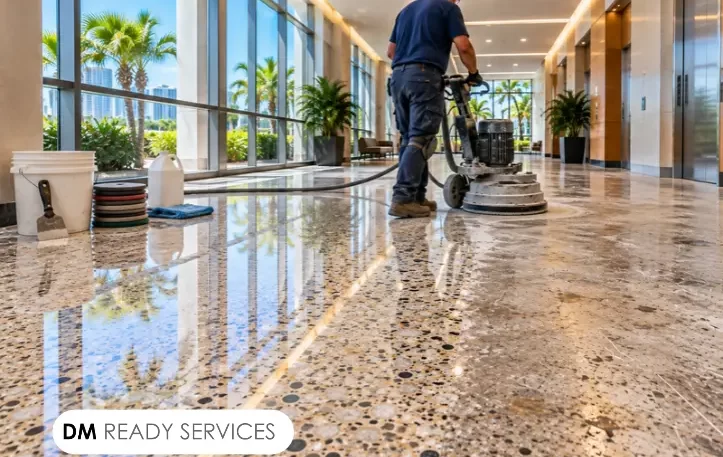
Professional terrazzo restoration follows a fixed sequence: inspect and prepare, strip old coatings, repair cracks and holes, grind with coarse diamonds, hone and polish through progressively finer grits, then seal. Most Tampa Bay residential projects take 2 to 4 days. A restored floor typically lasts 10 to 15 years before needing full restoration again.
- Grinding starts with coarse metal-bond diamonds (about 30 to 70 grit) and finishes with fine resin pads (800 to 3,000 grit).
- Each grit removes the scratches left by the one before it, so skipping steps leaves visible swirl marks.
- Cracks, chips, and carpet tack strip holes are filled with color-matched epoxy and real marble chips, then ground flush.
- In Florida’s humidity, a breathable penetrating sealer is the standard final step.
What are the steps to restore a terrazzo floor?
Terrazzo restoration has eight standard steps, from inspection to final sealing. The order matters: coatings come off before grinding, repairs are ground flush with the floor, and polishing only works once honing has removed every coarser scratch. The table below shows the sequence most professional crews follow.
| Step | What happens | Typical tools or grits | Why it matters |
| 1. Inspection and test area | Floor is checked for cracks, holes, stains, lippage, moisture and matrix type; a small test area is run | Moisture meter, test pads | Sets the starting grit and confirms the finish the floor can reach |
| 2. Protection and prep | Furniture is moved or protected; walls, cabinets and baseboards are masked | Plastic sheeting, tape | Keeps slurry and water off surrounding surfaces |
| 3. Stripping | Old wax, acrylic sealer, tile mastic, and carpet pad glue are removed | Stripper or coarse pads, auto-scrubber | Diamonds clog on coatings and can’t cut the stone underneath |
| 4. Coarse diamond grinding | Lippage, deep scratches and surface damage are ground away | Metal-bond diamonds, about 30 to 70 grit | Creates a flat, open surface and exposes all hidden damage |
| 5. Crack, chip and hole repair | Holes and cracks are filled with color-matched epoxy and marble chips, cured, then ground flush | Epoxy binder, matching aggregate, 70 to 120 grit metal | Makes repairs blend into the surrounding floor |
| 6. Progressive diamond honing | Finer abrasives remove the grinding scratch pattern | Transitional pads, then resin-bond 100 to 400 grit | Produces a smooth, matte or satin honed surface |
| 7. Densifying and polishing | Cement-based terrazzo may receive a densifier; fine resin pads build the shine | Densifier (cement matrix only), resin 800 to 3,000 grit | Hardens the surface and brings the finish up to satin or high gloss |
| 8. Sealing | A penetrating, breathable sealer is applied and allowed to cure | Penetrating impregnating sealer | Protects against moisture, soil and staining |
Some crews fill holes before the first grind, others after it. Either way, every repair is ground flush and honed along with the rest of the floor.
Why can’t you skip diamond grit levels when polishing terrazzo?
Each diamond grit removes the scratches left by the grit before it and leaves a finer scratch of its own. Skipping a level, for example jumping from 100 to 800 grit, leaves deeper scratches the fine pad can’t remove. They show up as swirl marks and haze under lobby lights or low afternoon sun.
As a rule of thumb, professionals roughly double the grit at each step, such as 50, 100, 200, 400, 800, 1,500 and 3,000. This is slower than jumping ahead, but it is the only way to get a uniform, reflective finish. It is also the most common reason cheap “polish only” jobs look good wet and dull once dry.
| Stage | Typical grit range | What it removes or creates | Resulting finish |
| Coarse grinding | 30 to 70 (metal bond) | Lippage, deep scratches, old patches | Rough, open surface |
| Transitional | 100 to 120 (metal or hybrid) | Grinding scratches | Flat, uniform matte |
| Honing | 100 to 400 (resin bond) | Transitional scratches | Smooth honed or matte |
| Polishing | 800 to 1,500 (resin bond) | Honing scratches | Satin to semi-gloss |
| High polish | 3,000 (resin bond) | Fine polishing scratches | High gloss, mirror-like |
How do professionals fix cracks and chips in terrazzo?
Professionals fix cracks, chips, and holes by filling them with an epoxy binder tinted to match the floor’s matrix, mixed with real marble chips that match the original aggregate. Once cured, the patch is ground flush and polished with the rest of the floor, so it blends in.
The most common repair in Tampa Bay homes is the row of carpet tack strip holes around a room’s perimeter. In 1950s and 1960s homes across St. Petersburg, Seminole Heights and Largo, terrazzo was often covered with wall-to-wall carpet for decades. Pulling the carpet reveals hundreds of small nail holes and adhesive stains.
- Hairline cracks are cleaned out and filled with color-matched epoxy.
- Wider cracks may need routing before filling. If a crack follows slab movement, it can reappear, so the crew should say whether the slab is stable.
- Chips and missing aggregate are rebuilt with matching chips set in tinted epoxy.
- Loose or damaged divider strips (the brass or zinc lines between color fields) are reset or replaced before grinding.
What is the difference between honing and polishing terrazzo?
Honing smooths terrazzo to a matte or satin finish using diamond abrasives up to about 400 grit. Polishing continues with finer grits, typically 800 to 3,000, to build a reflective shine. Every polished floor is honed first, but a honed floor can stop there if a low-sheen look is preferred.
| Honed finish | Polished finish | |
| Final grit | About 200 to 400 | About 800 to 3,000 |
| Appearance | Matte to satin, low reflection | Satin to high gloss, reflective |
| Shows scratches and scuffs | Less | More |
| Slip resistance when wet | Generally higher | Depends on finish; should be tested |
| Common uses | Entries, kitchens, pool-adjacent rooms | Living areas, lobbies, showrooms |
For commercial spaces, the final finish should be checked against the ANSI A326.3 wet dynamic coefficient of friction standard. Our article Is Terrazzo Flooring Slippery? covers slip safety in more detail.
How long does the terrazzo floor restoration process take?
Most residential terrazzo restorations in Tampa Bay take 2 to 4 days, including repairs, polishing, and sealing. A polish-only refresh on a sound floor can take 1 to 2 days. Large commercial projects take longer and are often phased over nights or weekends to keep the space open.
Time depends mainly on square footage, the number of repairs, how much coating has to be stripped, and the finish level. Epoxy repairs need curing time before they can be ground flush, and the sealer needs time to cure before furniture goes back. Ask your contractor for the specific sealer’s cure time.
Can you restore terrazzo without harsh chemicals?
Yes. Modern terrazzo restoration is mainly mechanical: diamond abrasives do the work that harsh chemicals once did. Wet grinding and polishing also greatly reduce dust. Chemical strippers may still be needed for heavy wax or adhesive, but low-odor products are available, and acidic cleaners should be avoided entirely.
Acid matters because terrazzo’s marble chips are calcium carbonate, which etches on contact with acids such as vinegar or some tile cleaners. That is why older “acid wash” or crystallization methods can dull or damage a floor over time. Final cleaning and aftercare should use a neutral pH stone cleaner.
How does Florida’s climate affect the terrazzo restoration process?
Florida conditions change three parts of the process: sealer choice, repair scope, and maintenance frequency. High humidity and slab moisture call for breathable penetrating sealers rather than surface films. Coastal sand and stormwater add wear and stains that must be ground out.
- Humidity and slab moisture. Terrazzo sits directly on a concrete slab. Film-forming coatings can trap vapor and cloud, which is why penetrating sealers are standard in Tampa Bay.
- Coastal sand. Homes and businesses near Clearwater Beach, St. Pete Beach and Dunedin see sand scratch entries and walkways faster, so those areas often need more honing.
- Storm and flood damage. Terrazzo is dense and can usually be restored after flooding. See Can You Restore Terrazzo After Water Damage?
- Cement vs. epoxy terrazzo. Most pre-1970s Florida homes have cement-based terrazzo, which can benefit from a densifier. Newer commercial floors, including many airport and lobby installations, are often epoxy terrazzo, which doesn’t take a densifier.
How do you maintain terrazzo after restoration?
To keep restored terrazzo looking new, dust mop daily or as needed, damp mop with a neutral pH stone cleaner, and use walk-off mats at entries. Avoid bleach, ammonia, vinegar and acidic cleaners. High-traffic commercial floors typically benefit from professional polishing every 3 to 5 years.
With that routine, a fully restored floor typically goes 10 to 15 years before needing another full restoration. For commercial floors, see our commercial terrazzo maintenance guide.
Should you restore terrazzo yourself or hire a professional?
Routine cleaning and resealing are reasonable DIY tasks, but grinding, honing and crack repair require planetary diamond grinders, multiple grit sets and color-matching experience. A rented buffer can’t level lippage or remove deep scratches. A DIY attempt with the wrong pads or acid cleaners often makes professional restoration harder and costlier.
| Task | DIY-friendly? | Notes |
| Dust mopping and neutral pH cleaning | Yes | Best way to extend time between restorations |
| Applying a penetrating sealer to a clean floor | Sometimes | Product choice matters in Florida humidity |
| Removing light wax buildup | Sometimes | Test first; avoid acidic strippers |
| Filling tack strip holes and cracks | No | Color matching and grinding flush take pro tools |
| Diamond grinding, honing and polishing | No | Requires planetary grinders and full grit sequences |
Curious what each level of work costs? See How Much Does Terrazzo Floor Restoration Cost vs. Replacement in Tampa Bay? for typical per-square-foot ranges.
Professional Terrazzo Restoration in Tampa Bay
DM Ready Services has restored terrazzo, marble, and natural stone floors since 2001, serving homeowners, property managers, general contractors, and designers across Hillsborough, Pinellas, Pasco, Polk, and Hernando counties. That includes terrazzo floor restoration in Tampa, terrazzo restoration in Pinellas County, and communities such as St. Petersburg, Clearwater, Largo, Dunedin, Riverview, and Odessa.
Related reading:
- The Basics of Terrazzo Floor Restoration in Florida
- How to Restore Terrazzo Floors to Look New
- What Is the Average Lifespan of a Terrazzo Floor?
Call (813) 625-6963 or request a free on-site estimate for your terrazzo floor.